
It’s important to dress appropriately for professional opportunities, to make the right impression. This isn’t always affordable, particularly for students. The Professional Clothing Closet was created to supplement student resources by providing free interview-ready items of clothing. Please read below to find out more and email Career Services if you have any questions!
Contact Info:

What is the Professional Clothing Closet?
The Professional Clothing Closet is a place where students can get professional clothing at no cost to themselves. We are open to all CWU students and alumni who need clothing for interviews, job fairs, industry conferences, or other professional opportunities. Items you may find include suits, skirts, pants, suit jackets, ties, belts, dresses, and shoes. Please note that the clothing closet is made almost entirely of donations; this means that there will not always be items of the right size or color for your needs.

Get clothes!
The primary location for the Professional Clothing Closet is located in our office in Bouillon 206 and is available during regular business hours (Monday-Friday, 8am-5pm). Please check in with our staff at the front desk. Current students will need to have their student ID number. Visitors can try on clothing in our private dressing room and are able to take up to a full outfit when they go.
*Please note that we do our best to have all donated clothing items laundered before they are placed in our closet, but encourage you to wash them again after taking them home.

Donate to us!
Ideal donations include gently used pieces of all sizes, including suits, jackets, pants, skirts, shirts, ties, belts and shoes. Donations that do not meet our definition of professional will be put in our Casual Closet, which is also made accessible to students at no cost.
All donations are tax-deductible.
Please drop off items at Career Services located in Bouillon 206 at 400 East University Way in Ellensburg, Monday-Friday, 8am-5pm. You can also call (509) 963-1921 or email career@cwu.edu to arrange drop-off or pick-up of your items. Thank you for supporting our Wildcats!
A Guide to Dress for Success
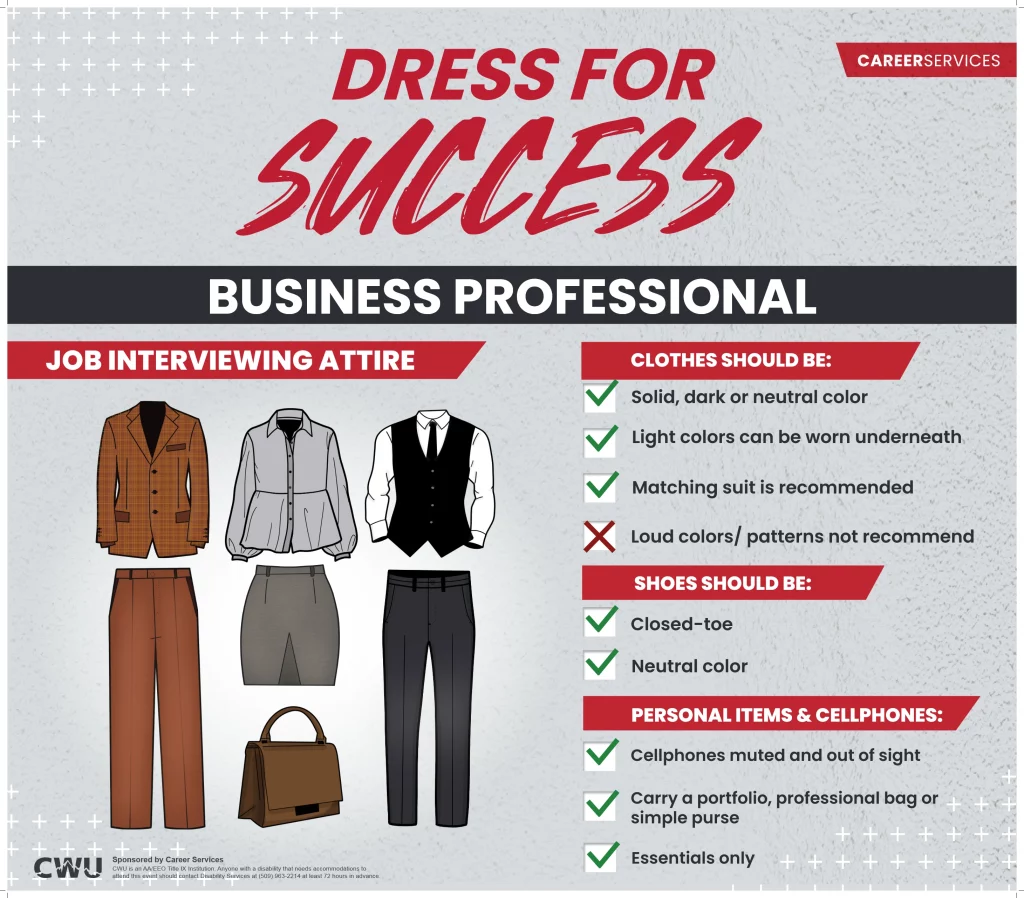
Business Professional
Clothing colors for business professional attire are typically solid, dark, and neutral. Bright colors and loud patterns are usually discouraged, though lighter colors make for good under-layers. Colors should match throughout the outfit, and shoes should be closed-toe. The goal is to look polished and professional. Keep your cellphone away and travel light with just the essentials!
The following clothes are typically appropriate:
- Pantsuit or skirt suit
- Dress
- Button-down shirt
- Blouse
- Sweater
- Dress shoes, heels or flats
- Tie
- Nice belt
- Cufflinks
Business Casual
Business casual dress allows for a little creativity compared to business professional. It maintains a polished look but formal items, such as ties, are no longer required. You can opt for brighter colors and small patterns but you should still aim for clean and polished looks. Shorts, sundresses, and athletic wear should generally be avoided.
The following items are common within the business casual dress code:
- Shift dress
- Pants
- Knee-length skirt
- Button-down shirt
- Polo shirt
- Knit shirt with collar
- Cardigan
- Sweater
- Blazer
- Simple shoes, flats or heels
- Accessories can be larger and more unique
- Nice belts
- Dress shoes or loafers

General Recommendations
Generally, clothes should be well-tailored, in good condition, and free of wrinkles and lint. Shoes and belts should be color coordinated.
Hair should be well-groomed, and any makeup or nail accessories should be natural in style. Jewelry is appropriate in moderation. Fragrances should be mild and not distracting. Finally, piercings or tattoos should align with the culture of your organization.
When in doubt, refer to the dress code section of your employee handbook. If there isn’t one, communicate with your boss and/or HR department! Always follow any guidelines set forth by Human Resources.

Extra Tips
If you are interviewing with a company, plan to dress at least one level more formal than their office dress code requires. Suits are usually the best option for interviews. While visiting a company for an interview or training, take note of what employees are wearing so you’ll have a better idea of their dress code.
If you’re short on ideas, model your wardrobe after what other people in your department are wearing. Most notably, pay attention to what your boss wears or others at their level.
When getting started, stick to the basics! Professional clothing is often expensive, sometimes prohibitively so. Start with basic pieces, such as classic pants, jackets, shirts or skirts, as described in the company dress code. You can add more articles of clothing and accessories as you gain a better understanding of what to wear!